Six-Month Report: 20 September 2025 – 20 March 2026
Introduction
The Amargi was launched on 20 September 2025 as an independent, grassroots-supported media platform committed to public-interest journalism on Kurdistan, Turkey, Iraq, Syria, Iran, and the Middle East, and issues of democracy, human rights, peace, and social justice. As well as covering the migrant communities in Europe and especially in Germany.
This six-month report is intended for our donors, funders, readers, and wider community. It is written in the spirit of transparency. We want to show clearly what we have achieved, where we have fallen short, and what we plan to do next.
Over the last six months, The Amargi has grown from a small launch team into a larger cross-border newsroom. We have reported on war, displacement, repression, and political and geopolitical change while trying to build an independent media institution in exile. That has been both meaningful and difficult. We are proud of what has been built so far, but we also know that strong journalism requires stronger structures, deeper capacity, and more sustainable support.
1. What we achieved in our first six months
A. Strong editorial output
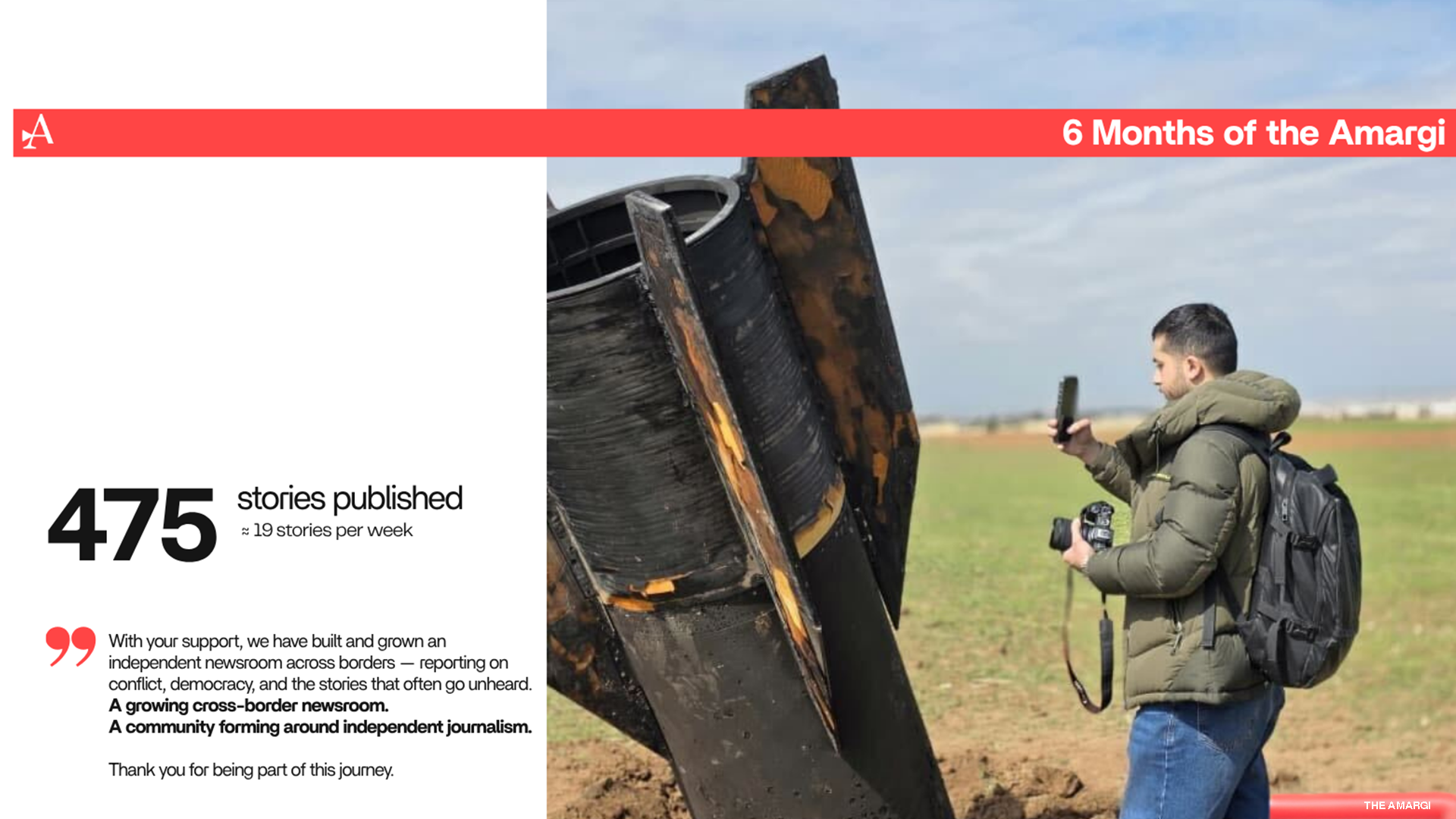
From 20 September 2025 to 10 March 2026, The Amargi published 475 pieces on its website. That equals an average of roughly 19 pieces per week over the reporting period.
Our output grew steadily after launch. We published 19 pieces in the final days of September 2025, then increased production month by month, reaching 95 pieces in January 2026 and 120 in February 2026. This shows that The Amargi has moved beyond launch momentum and developed into a functioning newsroom with regular output.
Our coverage was broad but remained focused on the issues that define our mission. Across the six-month period, our publishing included:
News, features, and reports: 276 pieces
Opinion: 114 pieces
Analysis: 54 pieces
Multimedia/Video: 43 pieces
In regional terms, our strongest coverage areas included:
Syria: 79 pieces
Turkey: 76 pieces
Iran: 67 pieces
Iraq: 30 pieces
This reflects our editorial strength in covering Kurdish affairs and wider regional developments at a time of war, political upheaval, and rapid change.
B. Growth of our network and newsroom
At launch, The Amargi began with a small team. Over six months, we expanded from 12 journalists to around 50 journalists, academics, and contributors, many of them working on a voluntary basis.
The publication log also shows the breadth of our network: during this period, our site carried work from more than 100 bylines, this diversity of more than 100 bylines is our strength as it is not easy to build trust among authors, journalists, academics, and contributors to pitch the media and be willing to become part of it. This is important for two reasons. First, it shows that The Amargi is not dependent on one or two voices. Second, it shows that we are building a plural platform that brings together journalists, researchers, analysts, and commentators across borders.
We also established our office in Leipzig, which gave the project an institutional base and helped move us from an idea into a functioning media organization.
C. Distinctive reporting and public relevance
One of our most important achievements has been editorial credibility. In a highly polarized media landscape, The Amargi has tried to remain independent, evidence-based, and humane. We have aimed to report seriously on conflict without reproducing hatred, propaganda, or dehumanization.
Over the past six months:
We reported from and about war zones and conflict settings
We interviewed actors and leaders from different and often opposing political sides
We produced exclusive and scoop-driven reporting
We built a reputation for coverage that supports peace, democracy, and human dignity
The publication data shows 24 pieces classified as “The Amargi Scoop,” which signals an early capacity for original reporting rather than only commentary or aggregation.
D. Recognition and visibility
Our work and our journalists gained visibility beyond our own platforms. According to our internal notes, The Amargi and its journalists were quoted, interviewed, or referenced by outlets including Newsweek, Der Spiegel, NTV, BBC, DW, CNN, and several Kurdish, Arabic, and regional media outlets.
One significant milestone was a feature on The Amargi by the Columbia Journalism Review, titled “A Newsroom in Exile Imagines a Free Kurdish Press.” This kind of recognition matters because it places The Amargi within a wider international conversation on press freedom, exile journalism, and independent media.
We also saw our journalism travel across languages. Our work was translated into Arabic, Persian, Turkish, French, Spanish, Kurdish, and German, helping us reach audiences beyond English-speaking readers.
E. Multimedia and audience growth
The Amargi has not remained only a text-based platform. We expanded our multimedia presence and began building a broader digital audience.
According to the information provided for this report:
Instagram: around 38.7k followers
YouTube: around 4.5k subscribers
X: around 4.5k followers
TikTok: around 6k followers
Some videos reached more than 1 million views
We also launched The Amargi Specials on YouTube to host documentaries and special reports, including our first documentary related to drone warfare in the context of Russia’s war on Ukraine.
This audience growth is important not only for reach, but for resilience. A grassroots-funded media platform needs a real community around it. These numbers show that such a community is beginning to form.
F. Partnerships and public engagement
The Amargi has also started to grow as a convening platform, not only a publishing platform. One example is our collaboration in the upcoming Turin University roundtable in March 2026, organized in partnership with academic institutions and public figures.
Our reporting also had wider public and political relevance. According to our notes, some of our reports were shown at the Italian Senate in order to highlight atrocities committed against Druze and Kurds in Syria. This demonstrates that our work is not only being read; it is entering political and public debate.
2. What we have not yet achieved
Transparency requires honesty. While the first six months were productive, several key goals remain unfinished.
First, our newsroom structure is still uneven. We need stronger desk development, especially for Iraq and Turkey, and we need a senior Middle East correspondent to deepen regional coverage and editorial coordination.
Second, our multimedia ambitions are ahead of our infrastructure. We want to turn more written reporting into video, podcast, and studio-based programming, but we still lack a proper studio setup and related production capacity.
Third, management has not grown at the same pace as journalism. We focused heavily on publishing and less on systems. As a result, we need stronger internal coordination, more regular team meetings, clearer workflows, and more strategic internship planning.
Fourth, our fundraising remains underdeveloped. Most support so far has come through our existing networks and community relationships. We have not yet built a strong online fundraising system, and while we have applied for grants, we have not yet secured enough responses or partnerships to match our ambitions.
Finally, our coverage mix still needs improvement. Politics, war, and geopolitics understandably dominated our first six months, but we want to broaden our journalism further into culture, lifestyle, sports, women’s issues, and migrant communities. We also want to produce more investigative reporting, which remains below where we want it to be.
3. Priorities for the next six months
For the next six months, our focus will be on consolidation, quality, and sustainable growth.
Our main priorities are:
1. Strengthen the newsroom
We aim to improve desk structure, especially on Iraq and Turkey, and recruit or secure support for a senior regional correspondent.
2. Build multimedia capacity
We plan to invest in a studio workflow so we can produce more video interviews, podcasts, explainers, and visual storytelling based on our reporting.
3. Grow key platforms strategically
We will place particular focus on X, TikTok, and YouTube, while continuing our current strategy on Instagram and Facebook.
4. Improve management and internal systems
We will introduce more regular team meetings, clearer operational roles, and a more intentional internship structure.
5. Expand public discussion and events
We want to organize more roundtables, political discussions, and community conversations, including in cities such as Berlin, Brussels, and London, with a stronger focus on migrant communities and the rise of the far right.
6. Diversify editorial coverage
We aim to increase reporting on culture, everyday life, women’s issues, sports, and social questions, while continuing to cover major political developments.
7. Increase investigative work
We want to dedicate more time and editorial support to deeply reported investigations and long-form public-interest journalism.
8. Build more sustainable fundraising and partnerships
We will work to improve online fundraising, donor communication, and institutional partnerships so that our growth is not dependent only on personal networks.
Upcoming Event
We are currently planning a public event on April 22, bringing together journalists, researchers, and community members to discuss independent media and developments in the region. Titled “Exile Talks: Kurdistan,” the event marks the anniversary of Kurdistan, the first Kurdish newspaper founded in Cairo in 1898, and reflects on the long tradition of Kurdish journalism in exile. It will explore how journalism functions in contexts where there is no state protection and, instead, ongoing repression—highlighting the transnational nature of Kurdish media shaped by displacement, political struggle, and restricted press freedom in countries such as Turkey, Iraq, Syria, and Iran. Organized in collaboration with CORRECTIV.Exile, the event invites participants to listen, engage, and exchange with Kurdish journalists and artists.
Conclusion
The first six months of The Amargi show that there is both a need and an audience for independent, grassroots-supported journalism rooted in Kurdistan and the wider Middle East. We have built a functioning platform, published 475 pieces, expanded our team, launched multimedia work, established an office, and earned recognition beyond our own immediate circles.
At the same time, we remain a young institution. We are still building the structures that can support better investigations, stronger desks, more consistent management, and long-term sustainability.
We are grateful to everyone who has supported us so far: our donors, readers, contributors, volunteers, and partners. Your support has made it possible for The Amargi not only to survive its first six months, but to begin imagining its future more seriously.
Our next task is clear: to turn early momentum into durable independent media.
If you would like to support the continuation of this work, we would greatly appreciate your contribution